 Agriculture, grounds & landscape supplies
 Automotive, fleet parts & tires
 Building materials & construction products
 Chemicals, ingredients & raw materials
 Electrical, lighting, data & security
 Gases & welding supplies
 Industrial / MRO supplies
 IT hardware, peripherals & business technology
 Janitorial, sanitation, disposables
 Lab, scientific & research supplies
 Lubricants, fuels & petroleum products
 Material handling & warehouse supplies
 Metals & metal service centers
 Office furniture & workplace fixtures
 Office supplies, paper, ink & toner
 Packaging, shipping & mailroom
 Paint, coatings, adhesives & sealants
 Pharmaceuticals
 Plastics, resins & engineered materials
 Plumbing / PVF
 Power transmission, bearings & fluid power
 Print, labels & forms
 Restaurant equipment & supplies
 Roofing, exterior & specialty building products
 Safety & PPE
 Tools, hardware & fasteners
 Uniforms, workwear & corporate apparel
Product Details
Review product information, specifications, and procurement details.
 Back to Search Results
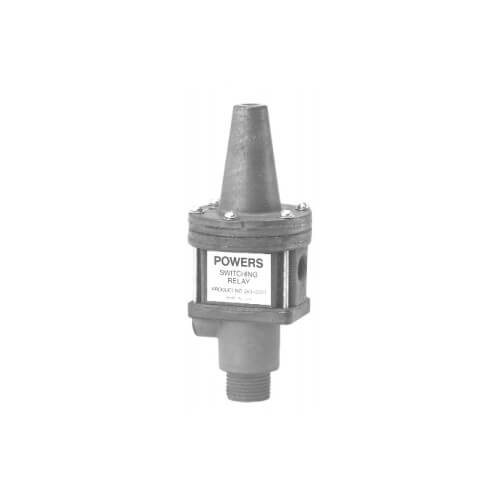
Pneumatic 2-Position Pilot Operated Switching Relay
The Powers 243 SW Switching Relay is a two-position, pilot-operated auxiliary device used for switching a common part from one pneumatic circuit to another. A mounting bracket is provided for mounting on a vertical or horizontal surface. Application: There are applications that require a low differential switching relay that can be triggered by a gradual input signal. The following describes ways of connecting the 243-0001 switching relay to achieve this. The low differential is achieved by connecting the relay so its differential is the opening and closing of only one valve of the two-valve relay mechanism. A restrictor must be used in the output (“D” port) of the relay to make sure the relay valve can bleed the output signal down to approximately zero. Since a restrictor is used in the output of the relay, the switching relay becomes a low capacity device. Its air capacity is limited by the size of the restrictor. If a high capacity switching device is required, two switching relays can be used, one piloting the other. For a single switching relay configuration as shown in Figures 2 and 3, the switching differential is 0.5 to 1.0 psi (3.4 to 6.9 kPa). For a double switching relay configuration as shown in Figure 4, the switching differential is approximately 0.5 psi (3.4 kPa).
Your Price
Contract Pricing
Product Overview
The Powers 243 SW Switching Relay is a two-position, pilot-operated auxiliary device used for switching a common part from one pneumatic circuit to another. A mounting bracket is provided for mounting on a vertical or horizontal surface. Application: There are applications that require a low differential switching relay that can be triggered by a gradual input signal. The following describes ways of connecting the 243-0001 switching relay to achieve this. The low differential is achieved by connecting the relay so its differential is the opening and closing of only one valve of the two-valve relay mechanism. A restrictor must be used in the output (“D” port) of the relay to make sure the relay valve can bleed the output signal down to approximately zero. Since a restrictor is used in the output of the relay, the switching relay becomes a low capacity device. Its air capacity is limited by the size of the restrictor. If a high capacity switching device is required, two switching relays can be used, one piloting the other. For a single switching relay configuration as shown in Figures 2 and 3, the switching differential is 0.5 to 1.0 psi (3.4 to 6.9 kPa). For a double switching relay configuration as shown in Figure 4, the switching differential is approximately 0.5 psi (3.4 kPa).
Full Specifications
Procurement Details
Documents
Related / Comparable Items
| Product | MPN | Description | Availability | Unit | Your Price |
|---|---|---|---|---|---|
| 52506 | Power Team® Manifold Body, For Use With: 9514 Model B 3-Position 4-Way Solenoid Controlled Pilot Ope ... | ● In Stock | PR |
$0.00 / PR
|
|
| 420417 | Power Team® Solenoid Valve, 4-Way, For Use With: 9516 3-Position 4-Way Pilot Operated Valve Assembly ... | ● In Stock | PR |
$0.00 / PR
|
|
| 420088 | Power Team® Basic Valve Assembly, 3-Way, For Use With: 9523, 9553 and 9589 Model B 10000 psi 2-Posit ... | ● In Stock | PR |
$0.00 / PR
|
|
| 16664-1 | Power Team® Solenoid Valve, For Use With: 9513 Model C 3-Position 4-Way Solenoid Controlled Pilot Op ... | ● In Stock | PR |
$0.00 / PR
|
|
| AK-42309-500 | The AK-42309-500 Positive Positioner Pneumatic Relay is used to accurately position an actuator wit ... | ● In Stock | PR |
$0.00 / PR
|